Showing posts with label food and drink. Show all posts

Thursday, 17 September 2009

Hold onto your Bhut: World's hottest chilli grown in county.


Spicy food enthusiasts are getting hot under the collar at the arrival of the world’s hottest chilli in Lincolnshire.

The crop of Bhut Jolokia chilli peppers have been grown at Doddington Hall and are set for inclusion in the hall’s shop and cafĂ© menu.

More commonly known as the King Cobra chilli or the Ghost Pepper, it is the hottest chilli plant ever produced, and was certified as such in the Guinness World Records 2007.

It rates nearly one million on the Scoville Scale, making it twice as hot as the previous record holder, the Red Savina pepper.

Owner of Doddington Hall Claire Birch explained that the Bhut Jolokia is one of five exotic chillies the hall is introducing to guests and visitors.

“The Bhut is just one of a few chillies we’ve been growing, and people have been taking a great interest,” she said.

Other chillies being grown include the Fatalie, the Fish, the Peruvian Lemon Drop and the Ring of Fire.

“Some of the chillies look really beautiful,” said Ms Birch.

“The Fatalie is a very hot three-inch fruit of a brilliant orange colour.

“The Fish is a pretty, stripy green and orange, and the Lemon Drop is a bright yellow with an intensely hot citrus flavour.

“The Ring of Fire is pretty much hot enough for most, though a lot of people want to try the Bhut.

“People are buying it to dry and display in their kitchens as a talking point. Chillies are really pretty so I think it’s a great idea.”

The Bhut is so spicy that, for safety reasons, it has to be handled with special protective gloves at all times.

Doddington Hall will also be holding a special cooking demonstration featuring the Bhut chilli and other fresh, seasonal ingredients at 11am on Saturday 19 September in the ground’s kitchen garden.

Led by local cooking enthusiast Amy Claridge, the fiery fruit will be used to make a chilli con carne.

Those looking to dabble with the Bhut and other such spicy chillies are invited to attend, try some free samples and take home a new recipe.

Ms Claridge explained she would be getting in as much practice as she could before the demonstration on Saturday.

“It’s obviously hotter than a normal chilli so I’m going to have a couple of run-throughs before I start cooking with it in front of people,” she said.

“I’m going to wear gloves and exercise caution as I’m dealing with pretty hot stuff. It’s like anything really, you’ve got to work with the ingredients you’ve got.”

Checked the names are spelt right for all the different chillies - everything's fine!

Wednesday, 2 September 2009

County's restaurants already feeling festive.


Every year Christmas seems to start earlier and earlier – and this year it feels like it has already begun.

Pubs and restaurants throughout Lincoln have started promoting and advertising their Christmas menus.

And the fact optimistic businesses are already preparing for the Christmas season comes despite the clobbering the economy has taken in the credit crunch.

Alan Ritson, owner of The Old Bakery in Burton Road, says his restaurant has actually seen an economic upturn in the past 12 months.

He said: “Loads of other people have been saying to me it’s been difficult through the downturn, but we’ve never been busier.

“On a regular day, we usually have a three or four-week waiting list.

“But for Christmas, we end up taking bookings up to a year in advance.

“We put the menu on the website in January and when it gets round to July and August, we’re already half full.

“We’ve been building a reputation over the past five years and each year is better than the last.

“We’ve never had to advertise, because we receive a lot of repeat business. People keep wanting to come back.”

The award-winning restaurant currently holds two AA rosettes, has received a Toptable Gold Award for two years in a row and is to be featured in The Good Food Guide 2010.

Mr Ritson believes restaurants such as his are thriving because people want to go somewhere nice for a special occasion.

He said: “Instead of going out regularly on a whim, people are going out once a month or every couple of months to celebrate these occasions. Seeing as they go out less often, people want to go to somewhere nicer, where they know they’ll get top-quality service.”

This confidence in the face of the recession is shared with many other restaurants throughout the city.

Paul Adams, supervisor at the Royal William IV, said they have not even started to worry about the Christmas period yet.

He said: “We’re confident we’re going to be fine considering this so-called recession. Every year we’re apprehensive and have the same doubts and questions.

“But we’ve always been successful and we’ve always been popular.

“I think we just need to be brave and optimistic.

“We’ll end up fully booked.

“But there’s no point in rushing these kinds of things.

“As long as we’ve put together a menu people like, then we’ll be fine.”

Tuesday, 25 August 2009

A different glass: 87,000 injuries are caused by glass every year. Could plastic be the solution to the problem?

Lincolnshire landlords and drinkers are objecting to plans to ban the traditional pint glass.

The move has been suggested by the Home Office to cut the estimated 87,000 injuries caused by glassware every year.

Official figures show that 5,500 people are attacked with glasses and bottles every year in England and Wales – while Lincolnshire police say between one and two people are glassed every weekend in the county.

And it is hoped that a range of safer plastic glasses – polycarbonates – can be developed for use in pubs.

But many county landlords say such a move would be unfeasible and will merely hasten the end of the England’s proud pub tradition.

Andrew Neall, landlord of the Wagon and Horses in Branston, said: “Drinking from glass is traditional. If you take away that tradition, it’s going to mean more people drinking at home – often to excess with cheap drink from supermarkets.

“At least in a pub there’s a landlord to keep an eye on things and stop people when they’ve had too much.

“What’s next? Taking away plates and cutlery for pub lunches? Replacing the windows so no-one falls through them? This really is taking things too far.”


Sitting in a pub, chatting to friends over a glass of beer has been an English way of relaxing for many hundreds of years.

But has Britain’s increasingly violent binge-drinking culture put an end to this simple pleasure?

The Home Office estimates that 87,000 injuries are caused by glassware every year – including 5,500 attacks.

In an effort to prevent some of the horrific injuries glasses can cause, designers will spend the next four months looking specifically at creating a drinking vessel with plastic and polycarbonate at the core – in other words, a plastic glass.

But the idea has met with horror by Lincolnshire landlords.

Tony Payne, chief executive of the Federation of Licensed Victuallers Associations, said: “When people use glass as a weapon they should be made an example and the punishment needs to fit the crime.

“Taking the glass away isn’t the answer as people can always find something else to use as a weapon.

“People prefer to drink from proper glasses and this is another burden for the pubs.”

Alex Rutherford-Doak, cor landlord of the Dog and Bone, off Monks’s Road, Lincoln, said: “Obviously, these incidents are serious, but I think different measures can be taken.

“In some cases, like in busy city bars, its necessary, but I don’t agree with a blanket ban.

“But plastic is not quite the same as drinking from a real glass.”

Campaign For Real Ale spokesman Iain Loe said that introducing polycarbonates to pubs would be an insult to local brewers.

“When brewers take their time and effort to create a tasty beer, it’s a crime against them to pour it into a bit of plastic that will give it a nasty, tacky taint,” he said.

“Plastic drinking vessels should be limited to open-air rock concerts, or someone’s back-garden, when they’re drinking a no-name beer.

Terry Kinsman, landlord of the Tap and Spile in Lincoln, explained that in pubs like his, it should be real ale in a real glass.

“As an outright replacement, I definitely don’t agree. If they get smashed, they’re just as dangerous as glass. People are always going to find a weapon if they want to. Taking away pint glasses isn’t the answer.”

Spokesperson for Lincolnshire Police Dick Holmes said: “From my experience I can say that most weekends, one or maybe two people are assaulted with a glass or bottle.

“In general terms, glassing can amount to bruising and minor cuts, but occasionally can lead to major cuts, disfigurement, or even the victim being scarred for life.

“Glassing falls under grievous bodily harm, which is often the result of somebody being assaulted by a beer glass. But we can’t give an exact number glassing victims, as we don’t keep a record of how the injury is inflicted, be it with a glass or other weapon.”

Tuesday, 4 August 2009

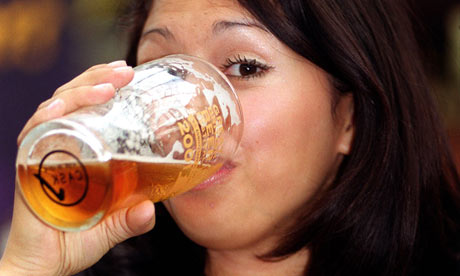
Figures reveal women are lapping up real ale.


The number of female real ale drinkers has doubled in the past year, with one in three now supping what campaigners dub Britain’s ‘national drink’.

Over 30 per cent of female drinkers say they have tried real ale, as opposed to 16 per cent in 2008.

These figures are the result of a survey of 1,000 adults conducted by the Campaign for Real Ale.

The survey also shows one in every two drinkers of alcohol has tried real ale, which is a 15 per cent increase on the previous 12 months.

The majority of those who have tried real ale in the past year went on to say what they drank had been brewed in their local area.

Stuart Bateman, the Managing Director of Lincolnshire’s own Batemans Brewery explained how the increased interest in ale from female drinkers has had an immediate effect on the way breweries conduct their business.

“To make a generalisation, if a couple are going out for the evening, it’s the lady who inevitably has the final say,” he said.

“Great steps have been made to try and get more and more females into pubs by showing they’re not the smoky, dingy places they used to be,” he said.

“Brewers have started to open their eyes to the fact that 50 per cent of their potential market is female, and there’s an increasing proportion of women who now regularly use pubs,” he said.

Research has shown women seem to prefer light, golden beers served in attractive glassware.

Mike Benner, the chief executive for the Campaign for Real Ale, explained the results of the survey were great news at such a difficult time for pubs.

“The findings show the increasing consumer demand for wide choice, top quality, and local produce,” said Mr Benner.

“Pubs are continuing to close at a rate of over seven a day, which is having a huge impact on community life,” said Mr Benner.

“Real ale can generally only be bought in pubs, therefore with greater popularity for Britain’s national drink comes further, much-needed publicity for community pubs,” said Mr Benner.

Victoria Whitehead, 24, a kitchen designer living in the centre of Lincoln, is an avid real ale enthusiast, and believes more women should broaden their horizons when it comes to alcoholic drinks.

“I drink all sorts of guest ales in places like the Green Dragon and the Horse and Groom.

“There are so many different flavours to try, so you’re always going to get something different. I’ll give anything a go once.”